
Debunking Common Misconceptions About Hall Effect keyboards — The True Meaning Behind Technical Specs
In recent years, Hall Effect keyboards have grown increasingly popular among high-performance users, thanks to their overwhelming speed advantage and Rapid Trigger capabilities.
However, many have misunderstood their true value — assuming that "the higher the precision, the better; the lower the setting, the better."
In reality, the true goal of using Hall Effect keyboards should be achieving faster response times, i.e., lower input latency, not "how low settings I can set without unintended key release."
Context: A Keyboard Can't Read Your True Intent
The core mechanism of Hall Effect keyboards is simple: a magnet is embedded in the moving part (the stem) of the switch, and as the key is pressed, the magnet’s position changes. The sensor determines the press depth based on changes in magnetic force.
It sounds straightforward, but there's a fundamental limitation:
- For smooth keystrokes, the stem must have a small amount of structural play, which can cause slight lateral wobble during vertical motion;
- Human finger force is not always stable (especially in rapid typing or gaming), and any small shake or variation in pressure can shift the magnet's position;
- From the sensor’s perspective, this change looks the same as a finger starting to release or press, because it only sees changes in magnetic force — not their cause;
- These variations can easily exceed 0.01mm, 0.02mm or even more.
As a result, the keyboard can’t definitively determine:
- Whether the user is trying to release the key;
- Or their finger just twitched slightly;
- Or they slightly changed the press angle.
Our keyboards offer a Key Tracker feature that visually displays what the keyboard interprets as press distance in real time. You can test different pressing behaviors yourself to see this in action.
The chart below shows readings from GATERON Jade PRO switch when waggled back and forth — the variations easily exceed 0.02mm.
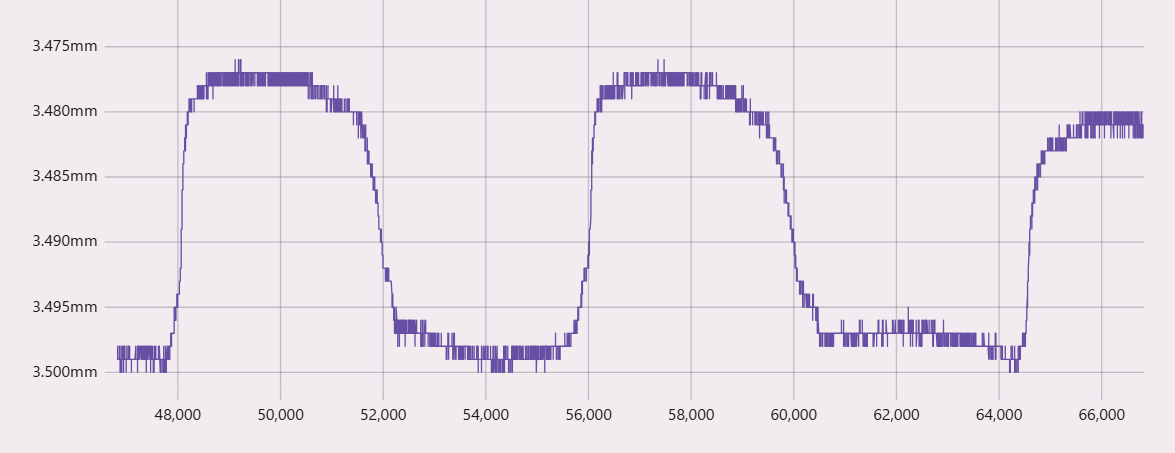
Note: Early-generation products may not show this effect due to slower sampling speeds and lower resolution compared to 80 and later models.
The Cost of “Stability”: “Algorithms” Are Not Free — They Come with Massive Latency
“Isn’t more algorithmic processing a sign of advanced tech?”
“Why do other keyboards seem fine?”
To maintain “stability” under extremely low thresholds (e.g., 0.02mm, 0.01mm, or even 0.00x mm), Hall Effect keyboards must use what are commonly called "algorithms."
But because magnetic switches can only sense magnetic strength and have no other source of information, all decisions must rely on “guessing” and waiting for more data.
In this case:
- The logic becomes more conservative;
- Data collection cycles must be extended.
The final outcome: latency doesn’t just increase a bit — it multiplies by factors, even tens of times.
A Simple Thought Experiment
We’ve already established that wobble can cause variations of 0.01mm to 0.02mm. Yet some keyboards allow actuation or reset points as low as 0.00x mm with seemingly no unintended releases.
This likely means they’re doing things like:
- Treating a portion near the bottom as "always triggered";
- Using ultra-conservative logic, e.g., requiring hundreds of samples to confirm a state change.
Obviously, the cost of these methods is that when the user lifts his finger normally, the keyboard still takes a lot of time to judge - it takes time for human fingers to move.
Shorter Actuation/Reset Distance ≠ Faster Response: Understanding This Trap
“If I set it to 0.01mm or 0.001mm, it should be faster!”
When actuation or reset distances are set too low, the keyboard must employ more complex logic to maintain stability.
This results in a paradox:
- The shorter the actuation distance, the harder it is to make a reliable judgment — thus requiring algorithmic intervention;
- The more algorithmic processing involved, the heavier the computational load;
- Heavier processing leads to slower response.
So in practice, extreme short-distance configurations may not deliver the high-speed experience you expect — in fact, they may do the opposite.
Test Latency ≠ Actual Latency: Some Testing Methods Are Severely Flawed
“But I’ve seen some keyboards test with great latency numbers?”
Some popular latency testing methods yield impressive figures, but their methodology often fails to reflect real-world usage.
These methods:
- Directly control the sensor’s output voltage to produce an instant jump (in microsecond level, 1000 microseconds = 1ms);
- Bypass all algorithmic processing entirely;
- Thus, their latency results only reflect theoretical minimums, not real-world behavior.
In actual usage, fingers move gradually (the time for finger movement is in ms level), which means you do not bypass those algorithms.
Therefore, impressive latency test numbers ≠ snappy user experience.
Our own claimed latency figures are based on real simulated press actions.
The Right Approach: Optimize Through Design
We believe that latency optimization should start with design — not just algorithm tricks.
- Use high-performance sensors and power ICs to reduce noise;
- Optimize PCB design with more layers to minimize interference;
- Employ better hardware architecture and more ICs to increase sampling rates, reducing the burden of inference;
- Use high-performance MCUs to accelerate processing;
- Perform extreme code optimization to fully utilize MCU capabilities and reduce execution time.
This ensures high-quality raw data without sacrificing speed, rather than relying on extreme algorithms to archive so-called "stability".
Frequently Asked Questions (FAQ)
Q: Other keyboards set actuation to 0.01mm or lower and work fine — why not yours?
A: Such ultra-low settings typically depend on extremely conservative logic. If they “feel fine,” it’s likely because some zones are just treated as “always triggered,” sacrificing real response speed or consistency.
Q: Don’t algorithms only add a tiny bit of latency?
A: No — in magnetic switch systems with fuzzy signals, algorithm time makes up the majority of the response. It often causes latency to multiply significantly.
Q: Can’t faster chips cancel out the delay from algorithms?
A: Faster chips reduce execution time and improve sampling speed, but they can’t remove the need to wait for more data. Better chips raise the ceiling — they don’t eliminate logical delays.
Conclusion
The true advantages of Hall Effect keyboards lie in:
- Customizable actuation points offering user freedom;
- Extremely fast response and ultra-low latency.
That’s why our goal should always be achieving faster response, i.e., lower input latency, to amplify these advantages — not giving them up in pursuit of “how low settings I can set without unintended releases.”